
ASTM A193 Grade B8M Bolts &
ASTM A194 Grade 8M Nuts
In the highly demanding realms of petrochemical processing, offshore oil and gas production, marine engineering, and thermal power generation, the precise pairing of ASTM A193 Grade B8M stud bolts with ASTM A194 Grade 8M heavy hex nuts represents a critical benchmark in corrosion-resistant, high-temperature structural bolting.
Engineered from highly alloyed AISI Type 316 and 316L austenitic stainless steel, this fastening set is explicitly formulated to withstand severe operational environments characterized by elevated temperatures, extreme mechanical pressures, and relentless aggressive chemical exposure.
The specific designation of "B8M" for studs and "8M" for nuts guarantees absolute chemical and metallurgical compatibility. This identical matched metallurgy completely eliminates the potential for galvanic corrosion and ensures uniform thermal expansion and contraction during intense cyclic heating and cooling phases, maintaining consistent clamping forces over extended lifespans.
Chemical Composition & Molybdenum Integration
The fundamental superiority of the B8M/8M hardware set over its standard Grade B8/8 (Type 304) counterpart lies entirely in its enhanced chemical composition, most notably the intentional alloying of molybdenum.
| Elemental Constituent | Composition Limits (%) | Metallurgical Function |
|---|---|---|
| Carbon (C) | 0.08 Maximum | Minimizes chromium carbide precipitation (sensitization) during high-temp service. |
| Manganese (Mn) | 2.00 Maximum | Potent deoxidizer; stabilizes the austenitic phase at lower temperatures. |
| Phosphorus (P) | 0.045 Maximum | Strictly limited impurity to prevent embrittlement and maintain fracture toughness. |
| Sulfur (S) | 0.030 Maximum | Restricted heavily to prevent hot-shortness (cracking) during forging. |
| Silicon (Si) | 1.00 Maximum | Deoxidizing agent; provides minor solid-solution strengthening. |
| Chromium (Cr) | 16.00 – 18.00 | Forms the self-repairing, continuous chromium oxide layer blocking oxidation. |
| Nickel (Ni) | 10.00 – 14.00 | Ensures the crystalline structure remains face-centered cubic (FCC) for extreme ductility. |
| Molybdenum (Mo) | 2.00 – 3.00 | Drastically improves resistance to localized pitting and crevice corrosion in chloride-rich environments. |
While standard Type 304 (Grade B8) relies solely on chromium and nickel, its passive oxide layer is highly susceptible to penetration by chloride ions (e.g., seawater). Molybdenum acts synergistically with chromium to exponentially fortify the passive oxide film, making Grade B8M the universal mandate for maritime and offshore installations.
Mechanical Properties: Class 1 vs. Class 2
Austenitic stainless steels cannot be hardened through thermal quenching. The manipulation of their strength relies entirely on specific thermomechanical processing routes.
Class 1 (Carbide Solution Treated): The steel is heated exceeding 1900°F (1040°C) to dissolve chromium carbides, then rapidly water-quenched. This yields maximum corrosion resistance and excellent dimensional ductility, but a lower yield strength (30 ksi).
Class 2 (Strain Hardened): For high-pressure piping requiring immense clamp loads. Following the initial carbide solution treatment, the material is subjected to severe plastic deformation (cold drawing) at room temperature. This radically increases yield strength up to 95 ksi for smaller diameters. Class 2 fasteners are distinctly marked with an underlined "B8MSH".
Class 2 Dimensional Strength Degradation
| Nominal Diameter | Min. Tensile Strength (ksi) | Min. Yield Strength (ksi) | Min. Elongation (%) | Max. Hardness |
|---|---|---|---|---|
| Up to 3/4" | 110 | 95 | 15 | 321 HBW / 35 HRC |
| Over 3/4" to 1" | 100 | 80 | 20 | 321 HBW / 35 HRC |
| Over 1" to 1-1/4" | 95 | 65 | 25 | 321 HBW / 35 HRC |
| Over 1-1/4" to 1-1/2" | 90 | 50 | 30 | 321 HBW / 35 HRC |
Engineering Note: Strain hardening is most severe at the outer surface and diminishes toward the core. Thus, minimum guaranteed strength profiles attenuate heavily as the nominal diameter increases.
ASTM A194 Grade 8M Nuts: Heavy Hex Advantage
Grade 8M nuts intended for pressure piping are predominantly manufactured to the "Heavy Hex" geometric profile (ASME B18.2.2). This configuration is significantly wider across the flats and thicker than standard hex nuts.
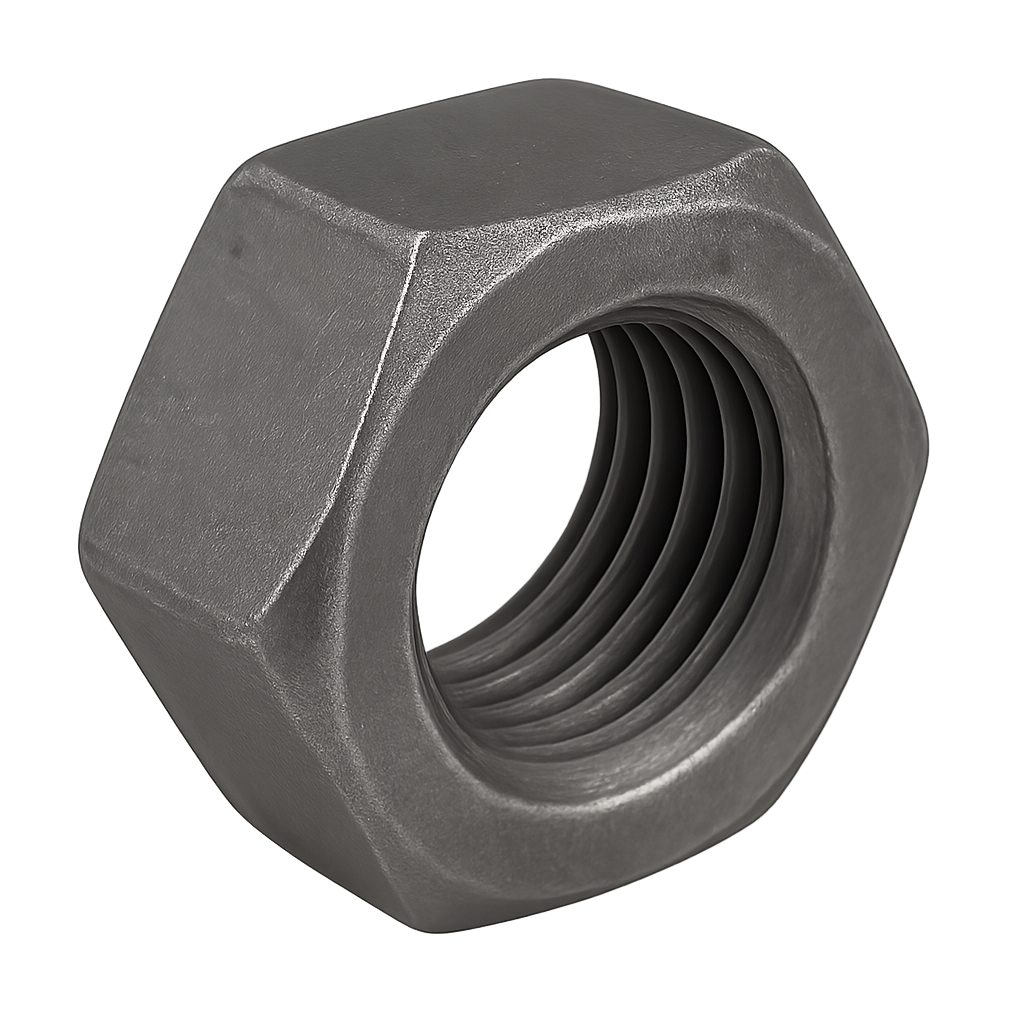
This augmented geometric mass ensures that if a flanged joint is massively over-torqued, the stud bolt itself will stretch and yield before the nut's internal threads strip out. Furthermore, the wider wrenching surface distributes compressive bearing loads over a much larger surface area on the flange face.
Proof Load Capabilities (Inch Series)
| Nominal Fastener Size | Threads Per Inch (TPI) | Calculated Stress Area (in²) | Required Proof Load (lbf) |
|---|---|---|---|
| 1/2" | 13 | 0.1419 | 24,830 |
| 3/4" | 10 | 0.3340 | 50,100 |
| 1" | 8 | 0.6060 | 90,900 |
| 1-1/2" | 8 | 1.4920 | 223,800 |
| 2" | 8 | 2.7700 | 415,500 |
Tribological Challenges: Thread Galling Mitigation
When an A194 8M nut is threaded onto an A193 B8M stud under high installation torque, the extreme contact pressure violently scrapes away the protective chromium oxide layer. The bare, highly ductile metallic asperities instantly bond at the atomic level, causing a catastrophic solid-state weld known as thread galling.
Evidence-Based Mitigation Strategies
- Tribological Lubrication: Heavy application of dry film lubricants or extreme-pressure pastes (Molybdenum disulfide, graphite) is critical. Baked-on fluoropolymer coatings (PTFE / Xylan) provide the ultimate dry-film barrier, ensuring repeatable torque-to-tension conversions.
- Attenuating Rotational Velocity: High-speed pneumatic impact wrenches generate massive heat spikes that guarantee galling. Use slow, continuous manual torquing or low-speed hydraulic tensioners.
- Thread Machining Methodology: Specify precision rolled threads rather than cut threads to drastically reduce the coefficient of friction.
Thermodynamic Envelopes: Cryogenic to High-Heat
Cryogenic Resilience (-450°F / -268°C)
Because the high nickel content permanently stabilizes the FCC crystal lattice, Type 316 stainless steel is virtually immune to the ductile-to-brittle transition temperature (DBTT) phenomenon. B8M bolting is ubiquitous in LNG processing and liquid oxygen storage.
High-Temperature Behavior (Class 1 vs Class 2)
- Class 1: Dimensionally stable at extreme heat, generally rated for sustained service temperatures up to 1500°F (815°C).
- Class 2: Strain-hardened internal stresses are thermodynamically driven to relieve themselves at high heat. Continuous exposure above 750°F (399°C) initiates rapid stress relaxation, causing the bolt to lose its enhanced yield strength and leading to severe flange leakage.
Grade B8M / 8M Hardware Solutions
We precisely machine Class 1 and Strain-Hardened Class 2 ASTM A193 Grade B8M bolting, ensuring flawless EN 10204 3.1 certification and traceability for severe maritime and chemical environments.
Frequently Asked Questions (FAQs)
What is the defining difference between ASTM A193 B8 and B8M?
While both are austenitic stainless steel bolting grades intended for high-temperature service, Grade B8 is forged from Type 304, whereas Grade B8M is forged from Type 316. B8M contains an intentional addition of 2.0% to 3.0% molybdenum, drastically increasing its resistance to localized pitting and crevice corrosion in chloride-rich environments like seawater.
What separates ASTM A193 B8M Class 1 from Class 2?
The difference lies in mechanical strength achieved through processing. Class 1 fasteners are simply carbide solution treated (annealed), providing standard strength (30 ksi yield) with maximum ductility. Class 2 fasteners undergo the same annealing process but are subsequently severely strain hardened (cold worked). This physically alters the internal crystalline structure, increasing yield strength up to 95 ksi for high-pressure clamping.
Why do ASTM A194 Grade 8M nuts use a "Heavy Hex" dimension?
ASTM A194 Grade 8M nuts are manufactured to the ASME B18.2.2 Heavy Hex standard, making them wider and thicker. This increased mass provides a larger thread shear area, ensuring the nut is always mechanically stronger than the bolt and will not strip. It also distributes bearing loads over a wider flange surface to prevent crushing.
How can thread galling (cold welding) be prevented when assembling B8M bolts and 8M nuts?
Prevention requires a multi-faceted approach: mandatory application of extreme-pressure anti-seize lubricants (containing molybdenum disulfide or graphite), drastic reduction of installation speed (avoiding impact wrenches), specifying fasteners with rolled threads, and avoiding the use of nylon-insert prevailing torque lock nuts.
What are the specific temperature limitations for ASTM A193 B8M Class 2 fasteners?
While Class 1 fasteners are stable up to 1500°F (815°C), Class 2 strength is derived from internal stresses created by cold working. Continuous exposure to temperatures exceeding 750°F (399°C) initiates rapid stress relaxation. The bolt will lose its enhanced yield strength, causing a total loss of clamping force and leading to inevitable gasket blowout.
