
ASTM A194 GRADE 7M NUTS
ASTM A194 Grade 7M Nuts Sample MTC Certificate
Access a comprehensive, professionally formatted Material Test Certificate according to EN 10204-2004: 3.1 for Alloy Steel Heavy Hex Nuts (ASTM A194 Grade 7M). Inspect the exact documentation your QA and engineering teams will receive with every Ananka Fasteners order.
What's Inside This A194 Gr 7M MTC Certificate
This sample mill test certificate mirrors the rigorous QA documentation package standard for high-temperature alloy steel nuts, specifically engineered and modified with a restricted hardness range for safe use in sour gas (H2S) service environments.
- Full Traceability: Certified with TC No.: C145/26-XX and corresponding ASTM specifications.
- Material Chemistry: Explicitly details the robust Chromium-Molybdenum alloy foundation (AISI 4140/4142 type steel), ensuring deep hardenability and excellent resistance to elevated temperatures.
- Strict Hardness Verification: Central to the 7M specification, this document guarantees the maximum hardness does not exceed 235 HBW (22 HRC) to comply with NACE MR0175, mitigating the risk of Sulfide Stress Cracking (SSC).
- Mechanical & Proof Load Testing: Validates the nut's Proof Load capability. Grade 7M allows a reduced proof load (min 793 MPa / 115 ksi) compared to standard Grade 7 to safely accommodate the essential lower hardness limit.
- Heat Treatment Tracking: Verifies the necessary quenching and elevated-temperature tempering (minimum 1150°F / 620°C) required to soften the alloy to the precise NACE-compliant range.
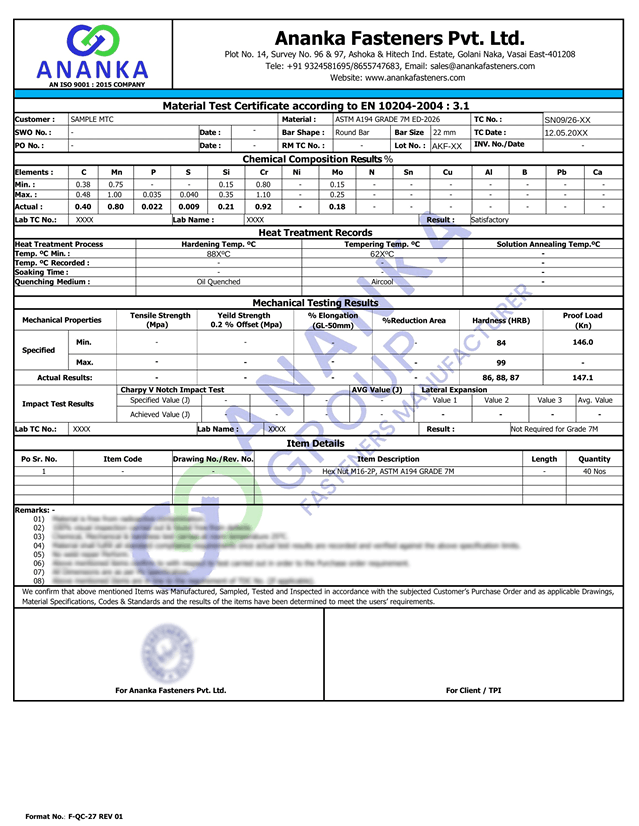
Live Preview: ASTM A194 Grade 7M Data
Review the standard parameters and layout before downloading the full document.
TC Number
C145/26-XX
TC Date
12.08.20XX
Material Spec
ASTM A194 GRADE 7M
Nut Shape / Size
Heavy Hex Nut / M24
Dimensions / Item
Heavy Hex Nut M24-3.0P
Quantity
250.00 NOS
Chemical Composition %
| C | Mn | P | S | Si | Cr | Mo |
|---|---|---|---|---|---|---|
| 0.42 | 0.85 | 0.015 | 0.010 | 0.25 | 0.95 | 0.20 |
| Min: 0.37 Max: 0.49 |
Min: 0.65 Max: 1.10 |
Max: 0.035 | Max: 0.040 | Min: 0.15 Max: 0.35 |
Min: 0.75 Max: 1.20 |
Min: 0.15 Max: 0.25 |
Mechanical Properties
| PROOF LOAD STRESS (MPa) | HARDNESS (HBW) |
|---|---|
| 850.50 | 215, 212, 218 |
| Min: 793 (115 ksi) | Min: 159 Max: 235 (22 HRC max) |
Standard References & Compliance
Our MTC certificates map to the demanding industrial standards for high-temperature and sour environment pipeline fasteners. The test reports confirm compliance with As Per ASME/ASTM A194 Grade 7M with respect to the tests carried out, specifically noting strict hardness controls.
| Standard / Requirement | Confirmation on Certificate |
|---|---|
| Visual Inspection | 100% visual inspection carried out & found free from defects. |
| Sour Service Compliance | Hardness verified max 22 HRC (235 HBW) complying with NACE MR0175 / ISO 15156. |
| Safety Requirements | Material is free from radioactive contamination. |
| Dimensional Accuracy | All dimensions, threads, and bearing surface tolerances conform to ASME B18.2.2. |
Certification Details
We confirm that above mentioned Items was Manufactured, Sampled, Tested and Inspected in accordance with the subjected Customer's Purchase Order and as applicable Drawings, Material Specifications, Codes & Standards and the results of the items have been determined to meet the users' requirements.
Documentation Standard
- EN 10204-2004: 3.1 Standard
- NACE MR0175 Conformity guaranteed
- Certified ISO 9001: 2015 Company
Heat Treatments
- Quenched & Tempered
- Tempering Temperature: Min 1150°F (620°C)
Testing Conditions
- 100% Hardness testing performed per ASTM A194 rules for 7M
- 100% visual inspection carried out
Technical FAQs — ASTM A194 Grade 7M MTC Certificate
What is the difference between Grade 7 and Grade 7M?
Both grades utilize the exact same alloy steel chemistry (Chromium-Molybdenum, similar to AISI 4140). The difference lies entirely in the heat treatment and resulting mechanical properties. Grade 7M is tempered at a higher temperature to strictly limit its maximum hardness to 235 HBW (22 HRC), whereas Grade 7 allows up to 352 HBW. Consequently, Grade 7M has a lower minimum proof load than Grade 7.
Why is the hardness strictly limited for Grade 7M?
The "M" designation means the nut is modified for sour service environments containing Hydrogen Sulfide (H2S), typically found in petrochemical processing and wellhead operations. High hardness in steel increases susceptibility to Sulfide Stress Cracking (SSC). Keeping the hardness at or below 22 HRC complies with NACE MR0175 and prevents catastrophic brittle failure.
Why is 100% hardness testing mentioned for this grade?
Because the hardness limit is a critical safety factor in preventing sour gas cracking, ASTM A194 requires that 100% of Grade 7M nuts (and Grade 2M nuts) be individually tested for hardness to ensure no single nut in the batch exceeds the 235 HBW / 22 HRC limit.

Your reliable manufacturing partner for high-quality industrial fasteners and global export.
Quick Links
Contact
- Address: Plot No - 14, Dewan And Shah Udyog Nagar, Golani Naka, Vasai East, Vasai-Virar, Waliv, Maharashtra 401208
- Email:
sales@anankafasteners.com
yogita@anankafasteners.com
globalsales@anankafasteners.com